After Reyes

1
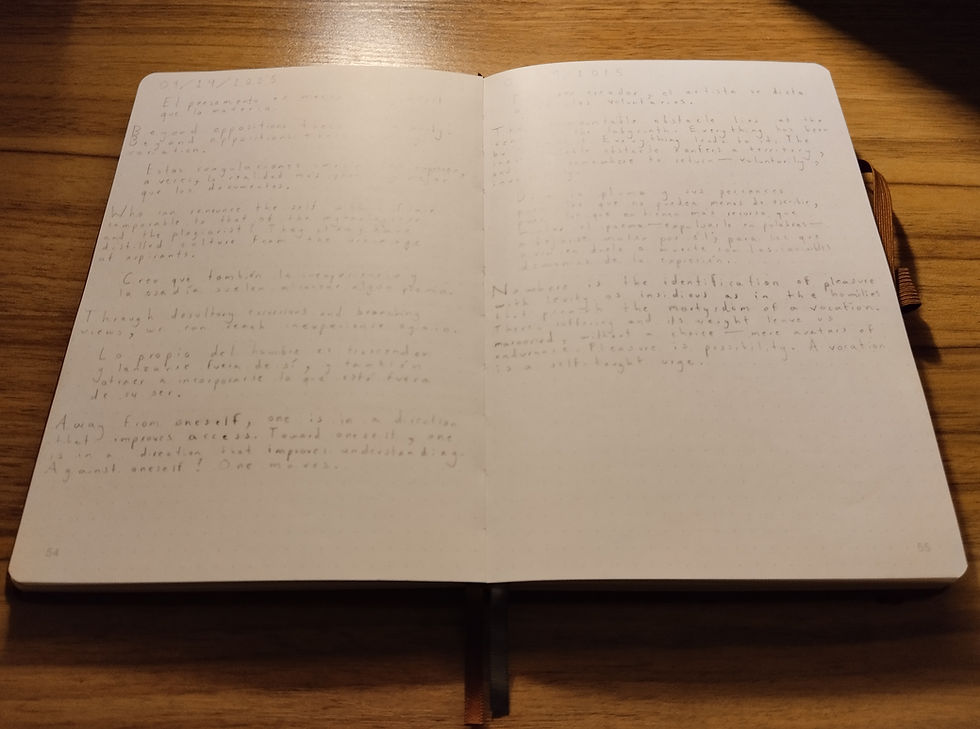
Beyond oppositions there is no unity. Beyond oppositions there is only variation.
2
Negation discloses the constituent parts. Negation pluralizes.
3
Theory and practice—the object and its shadow, the shadow and its object. They exist in isolation only when we are half-asleep.
4
The immediate reactions of the practical world narrow our sensibility, map onto it abrupt and unforgiving angles. It is the counterintuitive approximation that ascertains any sort of depth, and within this depth the proper domain of freedom.
5
While abstraction can be born from vigor, it usually betrays a fatigue with the specificity of life, which presses for incessant adjustments. Easier the beauty of the sunset than an unsettling tinge that reacquaints us with an adventitious upheaval.
6
The child already selects a parcel of the world—tragically vulnerable to the intrusion of duty-bound conviviality and expected taste.
7
Circumstances aid memory in its refusals and affirmations. To access a languishing image, one must blindside one’s system of dispositions.
8
The present that is saturated with past and future is the only present that we assimilate, weave into the fuliginous thread of consciousness. The present of the senses, the animal present, is a forceful lapse, which, prolonged, lowers the dynamism of consciousness to an iteration of reflexes.
9
Toward the past, gratitude—toward the future, curiosity. In the present, attention. Toward the past, derision—toward the future, trepidation. In the present, zeal. Modalities of integrity, possible and probable.
10
The short arc of efficiency accustoms us to discrete enjoyments. Grandeur is born somewhere between deferral and dissipation.
11
In erring through excess, we have seen truths and their unfolding, we have understood their consubstantiality with time. We must wait.
12
Boredom signals a rhythmic deficiency—indulgence in a transitory state. It reminds us that we are embodied, that we are not a monologue.
13
Impatience is an emotion deeply rooted in time. It ceases to be a spring of action when it becomes instantaneous—the instant depletes it into sheer complaint.
14
Those who long for discipline can conceptualize it only through the emotional atmosphere of submission. Someone other than oneself always knows best, harbors no doubts, and invariably reveals the path. Their talk of autonomy has the cadence of postcoital rumination.
15
We construe daily life with the remnants of our higher aspirations.
16
Away from oneself, one is in a direction that improves access. Toward oneself, one is in a direction that improves understanding. Against oneself? One moves.
17
Who can renounce the self with a flair comparable to that of the mythologizer and the plagiarist? They, too, have distilled culture from the wreckage of aspirants.
18
Skepticism imbues the mind that is assured of the boundaries of its dominion, eminently countable and classifiable; faith, the mind that is overwhelmed by a limitless expanse, countable and classifiable only between periods of ecstasy.
19
Yes, a language speaks us. But in opening it to unsuspected contacts, we can create the moment, the place, finally to speak ourselves.
20
What can we conjure against the ease of all automatisms? The trap, which forces deliberation. The unparalleled trap—art.
21
All momentum in art begins with the corruption of the canons of verisimilitude.
22
Great works of art resemble a manubial column. Tradition is there to be pillaged.
23
And once every art has emancipated itself, let it recreate the former union.
24
One of the great obsessions of the Baroque was also one of its great artistic conquests: the faith in permutations—each pursued from incoherence to coherence.
25
Each age has a form adequate to its energies. Experimentation is thus a necessity.
26
The feeling of irreality before a work of art is related to temperamental distance, not to any failure of realism. It dissipates as soon as there is a glimpse of the artist’s vision. All easy identifications, then, are perilously close to a form of aesthetic inertia.
27
Every return to a text subjects us to a new blindness and a new lucidity. But we should not fool ourselves: they are as irretrievable as the slant of light that suddenly broke the spell.
28
The consecration of the intermediary turns a working life into a long pupilage in double-dealing sensibilities.
29
The fanatic does not wish to understand or appreciate the object of devotion. There is only one true pleasure: the paroxysm of consumption.
30
Nowhere is the identification of pleasure with levity as insidious as in the homilies that preach the martyrdom of a vocation. There, suffering and its weight leave us moored, without a choice—mere avatars of endurance. Pleasure is possibility. A vocation is a self-taught urge.
31
The myriadigamous nature of the work is almost always concealed underneath the bravado of erudition or the frugality of elegance. A gravid silence is a great memorial to love.
32
The threading movement of description, even in failure, reveals the concinnity of consciousness.
33
Reading is living. Writing is living. The imaginative realm, properly explored, involves the body through a rigorous, concentrated immobility in which everything is performed. Only diffuseness of conception can suggest inactivity.
34
Literature is the tmesis between forms of knowledge.
35
Art grants a proliferation of forms—grants the world opportunities to give itself anew.
36
Not all conscious streams manage to turn into rivers. There are creeks, rills, freshets, brooks. It all depends on the surrounding landscape of intellect, will, and emotion.
37
Philosopher and scientist alike can see to it that metaphor retain its cognitive function. Yet artist and priest alike must enact its mirabiliary function.
38
Knowledge brings self-consciousness only to those who believe in complete mastery. The seasoned worker is as ignorant as the initiate—and thus, as free.
39
Through desultory excursions and branching views, we can reach inexperience again.
40
The insurmountable obstacle lies at the center of the labyrinth. Everything has been built around it. Everything leads to it. The insurmountable obstacle confers a territory, and thus somewhere to return—voluntarily, involuntarily.


Comments